Social Science Homework
10 days of Power Sharing, Federalism, Development & Economics.
Day 1 — Power Sharing (Introduction + Belgium & Sri Lanka)
1. Define power sharing.
- Power sharing is the distribution of power among different organs and levels of government.
- It helps to reduce the possibility of conflict between social and ethnic groups.
- It ensures political stability and strengthens the democratic fabric of a nation.
2. Write about the ethnic composition of Sri Lanka and Belgium.
- Belgium consists of 59% Dutch speakers, 40% French speakers, and 1% German speakers.
- In Brussels, the capital of Belgium, 80% are French speakers and 20% are Dutch speakers.
- Sri Lanka has 74% Sinhala speakers, 18% Tamil speakers, and about 7% Christians.
3. What percentage of people in Sri Lanka were Sinhala speakers?
- Sinhala speakers made up approximately 74% of the total population in Sri Lanka.
- They formed the absolute linguistic majority community in the island nation.
- This large majority allowed them to dominate the political and administrative systems.
5. Compare Belgium and Sri Lanka's handling of diversity. Which model was better and why?
- Belgium accommodated diversity through power-sharing arrangements and equal representation.
- Sri Lanka chose majoritarian policies that favored Sinhala speakers and marginalized Tamils.
- The Belgian model was better because it avoided civil war and kept the country united.
8. Write a newspaper report on Sri Lankan majoritarianism.
Day 2 — Forms of Power Sharing
2. What is horizontal power sharing?
- It is the division of power among different organs of government at the same level.
- The power is shared evenly among the Legislature, Executive, and Judiciary.
- This system allows each organ to check the others, creating a balance of power.
3. What is meant by coalition government?
- It is a government formed by an alliance of two or more political parties.
- This happens when no single political party wins a clear majority in the elections.
- The partners adopt a common minimum program to govern the nation together.
4. Define community government.
- It is a type of government elected by people belonging to one specific language or cultural community.
- Belgium is a primary example where French, Dutch, and German speakers have such a government.
- It handles community-specific issues regarding educational, cultural, and language matters.
5. Why is power sharing called the spirit of democracy? Explain prudential and moral reasons for power sharing.
- Power sharing is essential because a democratic rule involves sharing power with those affected by it.
- Prudential reasons state that power sharing avoids social conflict and ensures political stability.
- Moral reasons emphasize that power sharing is valuable in itself and forms the true soul of democracy.
7. Make a mind map showing forms of power sharing.
- Horizontal distribution: Power is shared among the Legislature, Executive, and Judiciary.
- Vertical distribution: Power is shared among Central, State, and Local levels of government.
- Social groups: Power is shared among different religious, linguistic, and minority groups.
- Political structures: Power is shared among various political parties, pressure groups, and movements.
8. Create a slogan promoting unity in diversity.
- Slogan 1: Different cultures, different faces, united together in all places.
- Slogan 2: Our diversity is our strength, keeping India united through its length.
- Slogan 3: Many languages, many creeds, one great nation for all our needs.
Day 3 — Federalism (Basics)
1. Define federalism.
- Federalism is a system of government where power is divided between a central authority and constituent units.
- It features at least two distinct tiers of government operating simultaneously.
- Each tier has its own specified jurisdiction in matters of legislation, taxation, and administration.
3. What is a unitary government?
- It is a system where there is either only one level of government or sub-units are subordinate.
- The central government holds all supreme administrative and legislative powers.
- State or local units can only exercise powers that the central government chooses to delegate.
5. Differentiate between 'coming together' and 'holding together' federations.
- Coming together involves independent states joining voluntarily to form a bigger unit, like the USA.
- Holding together involves a large country dividing its power between the national state and constituent units, like India.
- In coming together, states usually have equal power, while in holding together, the center is often stronger.
6. Why is India called a federal country even though the Constitution says "Union of States"?
- India has a clear three-tier system of government consisting of Union, State, and Panchayats.
- The Constitution explicitly demarks the legislative jurisdictions through three separate lists.
- The judiciary acts as an independent umpire to resolve disputes between different levels of government.
7. Draw a flowchart showing features of federalism.
                  ┌────────────────────────┐
                  │ FEATURES OF FEDERALISM │
                  └───────────┬────────────┘
                              │
                              ▼
┌───────────────────────────────────────────────────────────┐
│ 1. TWO OR MORE TIERS                                      │
│ └─► Government is organized into central, state, and      │
│     local levels.                                         │
└─────────────────────────────┬─────────────────────────────┘
                              │
                              ▼
┌───────────────────────────────────────────────────────────┐
│ 2. SEPARATE JURISDICTIONS                                 │
│ └─► Each tier has constitutional authority over           │
│     legislation and taxation.                             │
└─────────────────────────────┬─────────────────────────────┘
                              │
                              ▼
┌───────────────────────────────────────────────────────────┐
│ 3. CONSTITUTIONAL GUARANTEE                               │
│ └─► The existence and authority of each tier are safely   │
│     guaranteed by the constitution.                       │
└─────────────────────────────┬─────────────────────────────┘
                              │
                              ▼
┌───────────────────────────────────────────────────────────┐
│ 4. INDEPENDENT JUDICIARY                                  │
│ └─► Courts have the supreme power to interpret the        │
│     constitution and check government powers.             │
└───────────────────────────────────────────────────────────┘
Day 4 — Federalism in India
1. Name the three lists in the Indian Constitution. Give two examples each.
- Union List: Contains subjects of national importance like Defense and Foreign Affairs.
- State List: Contains subjects of local and state importance like Police and Agriculture.
- Concurrent List: Contains subjects of common interest like Education and Forests.
3. What are residuary subjects?
- These are subjects that do not fall under any of the three original constitutional lists.
- They include modern matters like Computer Software and Cyber Laws that arose after constitution-making.
- The Union Government holds the exclusive power to legislate on these residuary subjects.
5. Why can't Parliament alone change power-sharing arrangements?
- The federal structure is part of the basic foundation of the Indian Constitution.
- Any amendment requires a two-thirds majority approval in both houses of Parliament.
- It must also be ratified by the legislatures of at least half of the total states.
6. Explain the role of judiciary in federalism.
- The judiciary oversees the implementation of constitutional provisions and procedures.
- High Courts and the Supreme Court settle disputes between different levels of government.
- It prevents the misuse of power by interpreting the division of powers objectively.
8. Find your state's official language and write about its importance.
- The official language of Punjab is Punjabi, written in the Gurmukhi script.
- It ensures smooth local administration and makes governance accessible to ordinary citizens.
- It preserves the rich cultural heritage, literature, and historical identity of the region.
Day 5 — Federalism in Practice
1. What are linguistic states?
- Linguistic states are states created on the basis of shared spoken languages.
- Boundaries were redrawn so that people speaking the same language lived in the same state.
- Examples include Punjab for Punjabi speakers and Gujarat for Gujarati speakers.
2. How many scheduled languages are recognised in India?
- The Eighth Schedule of the Indian Constitution recognizes exactly 22 scheduled languages.
- Hindi is identified as the official language, but it is not imposed as a national language.
- Candidates can choose to take central civil service examinations in any of these languages.
3. What is decentralisation? Why was decentralisation needed in India?
- Decentralisation is when power is taken from central and state governments and given to local governments.
- India is a vast country, and local problems are best settled at the local village or city level.
- It fosters direct democratic participation and empowers citizens at the grassroots level.
5. How did linguistic states strengthen India?
- Creating linguistic states stopped potential separation demands and kept the country unified.
- It made administration much easier and more efficient across different cultural regions.
- It showed deep respect for diversity, which strongly bound democratic relations.
7. Interview a local government representative (Sarpanch/Councillor) and write 5 findings.
- Finding 1: The local representative focuses primarily on rural road connectivity and clean water supply.
- Finding 2: Fund allocation from the state government is often delayed, affecting local projects.
- Finding 3: Gram Sabhas are regularly conducted to list out the village development requirements.
- Finding 4: Waste management and setting up solar streetlights are their current environmental priorities.
- Finding 5: Providing self-employment opportunities for local youth remains a major ongoing challenge.
Day 6 — Development
1. What is development?
- Development is a comprehensive process that implies progress, growth, and improvement in life quality.
- It includes economic growth along with social changes like freedom, security, and equality.
- It refers to the fulfillment of people's aspirations and long-term desires.
2. Why do different people have different development goals?
- People come from entirely different life situations and social backgrounds.
- What is an immediate necessity for a landless laborer differs from a rich farmer's needs.
- Every individual seeks things that are most important to fulfill their personal aspirations.
3. Define per capita income.
- It is the average income earned per person in a given country in a specified year.
- It is calculated by dividing the country's total income by its total population.
- It is used by the World Bank to compare and classify economic development across countries.
5. "Development for one may not be development for another." Explain with examples.
- Industrialists want large dams to generate electricity for running factories.
- However, building these dams submerges land and disrupts the lives of local tribal people.
- Therefore, what brings progress to one group can bring total destruction to another.
6. Why is average income not a complete indicator of development?
- Average income completely hides the unequal distribution of wealth among the population.
- It does not tell us how income is actually shared among rich and poor citizens.
- It completely ignores non-material indicators like health, literacy, and gender equality.
7. Write your personal development goals for the next 10 years.
- Complete secondary and higher education with excellent academic performance.
- Gain advanced skills in computer technologies and system hardware engineering.
- Secure a stable and meaningful career to achieve financial self-reliance.
Day 7 — Comparing Countries/States
1. What is Infant Mortality Rate?
- It indicates the number of children that die before the age of one year.
- It is calculated as a proportion of 1,000 live children born in that specific year.
- A lower rate indicates high-quality medical healthcare and maternal facilities.
2. What is Literacy Rate?
- It measures the proportion of literate population in the 7 years and above age group.
- A person is literate if they can read and write with understanding in any language.
- It serves as a vital index for human resource development and educational growth.
3. What is Human Development Index?
- It is a composite index published annually by the United Nations Development Programme (UNDP).
- It ranks countries based on educational levels, health status, and per capita income.
- It gives a broader, more accurate picture of human well-being than economic growth alone.
5. Why are health and education important indicators of development?
- Healthy and educated citizens form productive human capital for economic development.
- They allow individuals to access better job opportunities and increase their standard of living.
- Good health and education improve the general quality of human life and social welfare.
7. Collect newspaper data on any Indian state and prepare a development report.
8. Make a bar graph comparing literacy rates of 3 states.
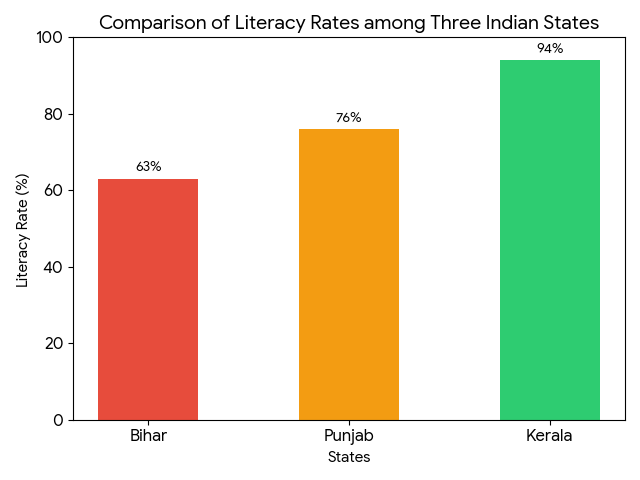
- Kerala: Dominates at the top with a literacy rate exceeding 94 percent.
- Punjab: Occupies a middle position with a stable literacy rate around 76 percent.
- Bihar: Sits at a lower level with a literacy rate close to 63 percent.
Day 8 — Sustainable Development
1. What are renewable resources and non-renewable resources?
- Renewable resources are replenished by nature over time, such as solar energy and wind.
- Non-renewable resources have fixed stocks and get exhausted after years of use, like coal.
- Sustainable development demands shifting focus from non-renewable to renewable energy sources.
3. Define sustainable development.
- It is development that meets current needs without compromising future generations' capacity.
- It focuses on long-term resource preservation rather than rapid short-term extraction.
- It balances economic growth with proper environmental protection and care.
4. Give two examples of environmental degradation.
- The depletion of groundwater tables due to excessive extraction for agriculture and industries.
- Heavy air and water pollution caused by industrial emissions and toxic waste dumping.
- Severe deforestation leading to loss of biodiversity and rapid soil erosion.
5. Why should future generations be considered while planning development?
- Earth's natural resources are finite and can be completely exhausted if overused today.
- Future generations have an equal right to enjoy a clean, resourceful environment.
- Reckless development today leaves a degraded planet filled with climate hazards for them.
6. Suggest solutions to balance development and environment.
- Promote widespread usage of green renewable energy resources like solar power.
- Enforce strict laws regarding industrial waste treatment before disposal into rivers.
- Encourage rainwater harvesting and large-scale afforestation drives across regions.
8. Write a short paragraph on pollution in your locality.
Day 9 — Sectors of Indian Economy
1. Define primary sector.
- It includes activities undertaken by directly exploiting natural resources.
- Examples of this sector are agriculture, dairy, fishing, forestry, and mining.
- It forms the essential raw material base for all other economic sectors.
2. Define secondary sector.
- It covers activities where natural products are changed into manufactured goods.
- This transformation happens through industrial manufacturing or manual processing methods.
- Examples include manufacturing cloth from cotton and making bricks from clay.
3. Define tertiary sector.
- This sector provides crucial support services to the primary and secondary sectors.
- It does not produce tangible goods directly but generates essential services.
- Examples include transport, banking, communication, storage, and software engineering.
5. Why is tertiary sector growing rapidly in India?
- The government has expanded basic services like hospitals, educational institutions, and defense.
- Development of agriculture and industry has directly boosted transport, trade, and storage.
- Rising income levels have increased public demand for tourism, shopping, and private schooling.
6. Explain interdependence of sectors with examples.
- Cotton from the primary sector goes to mills in the secondary sector to become cloth.
- The secondary sector needs trucks from the tertiary sector to transport these finished clothes to markets.
- Farmers require industrial tractors and banking services to successfully cultivate crops.
8. Observe your locality and list 10 jobs under different sectors.
- Primary sector: Farming and dairy animal rearing.
- Secondary sector: Brick-kiln working, grain milling, and construction.
- Tertiary sector: Shopkeeping, teaching, truck driving, mobile repairing, and banking.
Day 10 — Employment & Revision Task
1. What is GDP?
- Gross Domestic Product is the total value of all final goods and services produced within a country.
- It is calculated over a specific period, usually one financial year.
- It shows the overall size, health, and performance of a nation's economy.
2. What is disguised unemployment?
- It is a situation where more people are working than are actually required.
- The extra workers' marginal contribution to total production is completely zero.
- If these extra people are removed, total production remains entirely unaffected.
3. Differentiate between organised and unorganised sectors.
- Organised sector offers fixed working hours, job security, and assured employee benefits.
- Unorganised sector lacks employment security, health benefits, and fixed wage structures.
- Organised enterprises are officially registered with the government, while unorganised units are not.
5. Why does agriculture employ more people but contribute less to GDP?
- Agriculture suffers from severe underemployment and widespread disguised unemployment.
- The sector has lower productivity compared to expanding industrial and service sectors.
- Modern technical upgrades have not reached a vast majority of small landholders.
6. Suggest ways to generate employment in rural areas.
- Provide low-interest bank loans to farmers for setting up irrigation facilities.
- Invest heavily in rural infrastructure like cold storage and connecting roads.
- Promote agro-processing industries and local tourism hubs in village clusters.
7. Write a reflection: "What I learned during holidays?"
Day 11 to 20 — Project Work on "Consumer Rights"
- Objective: Explore how consumers are exploited in markets and their legal safeguards.
- Coverage: Study the Consumer Protection Act (COPRA) and the role of consumer forums.
- Content: Identify essential consumer rights like Right to Safety and Right to Choose.
- Outcome: Learn about safety labels like ISI, AGMARK, and consumer awareness slogans.